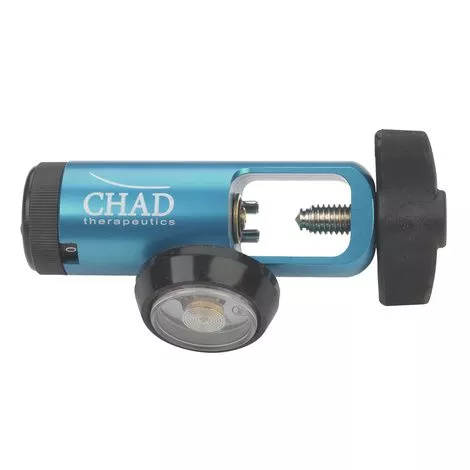
Features of Drive Chad CGA 870 Oxygen Regulator
Oxygen Flow Control Regulators:
- Pressure reducing devices which lower oxygen pressure from a cylinder to levels that can be safely used by the user
- Intended for the administration of oxygen to patients who need increased oxygen levels to improve their breathing conditions
- In addition, some models may be used in emergency situations
- In an emergency situation, be sure to contact a physician or EMS immediately
- 100% quality QC tested in the USA
- 20-micron, sintered-bronze inlet filter
- All flows tested to an accuracy within +/- 15% tolerances
- Ergonomic t-handle for easy tightening
- FDA recommended Viton and brass seal washers
- Inlet pressure:
– 200-3000 PSI - Outlet pressure:
– 50PSI
More About Drive Chad CGA 870 Oxygen Regulator
- Use:
– Be sure the oxygen regulator is in the “off” position by rotating the knob counterclockwise to the “0” position.
– For safety, be sure you are not directly in front of or behind the regulator when opening the cylinder valve.
– Slowly turn the cylinder valve on (counterclockwise), about one full turn.
– If you can hear a hissing sound, there is a leak in the system. Turn the cylinder off and turn the regulator on to relieve any built-up pressure.
– Try tightening the regulator to the cylinder and opening the cylinder again. If this does not help, shut the system down again and contact a service representative.
– Never attempt to repair a regulator or cylinder yourself.
– Adjust the flow rate setting by turning the knob clockwise until the desired setting shows through the window.
– If the cylinder pressure falls below 300 PSI, you should exchange the cylinder for a full one
– To turn off the system, close the cylinder valve, wait for oxygen to flow out of the regulator, and turn the regulator to the “0” position.
– Never try to remove the drive oxygen regulator unless the cylinder is off and pressure has been relieved. - Set Up:
– Inspect and install the cylinder using instructions from qualified personnel.
– Be sure to purge the cylinder valve seat of debris.
– Inspect the regulator for oil or grease. If these are visible, do not use the regulator.
– Be sure the sealing washer is in place in the yoke inlet.
– Slip the yoke over the cylinder post and fit the pins into the holes on the cylinder valve. The pins should fit easily into these holes.
– Turn the t-handle clockwise until the screw point is seated in the dimple on the cylinder valve.
– Be sure the regulator is tightened snugly onto the cylinder. Attach the oxygen supply tubing to the barbed outlet connection. - Warnings:
– Federal law restricts this device to use by or on order of a physician. Only use as prescribed by a physician.
– This CGA 870 oxygen regulator should only be used on patients who are breathing; do not use to resuscitate non-breathing patients.
– Do not use oil, grease, or any other flammable material. Keep out of reach of children.
– Do not smoke in an area where oxygen is in use.
– Do not use this CGA 870 regulator unless you have been trained in its proper use or are under the supervision of someone trained in its use.
– If the pressure relief valve on the underside of the regulator begins to vent oxygen, turn off the system and remove the unit until it can be serviced.