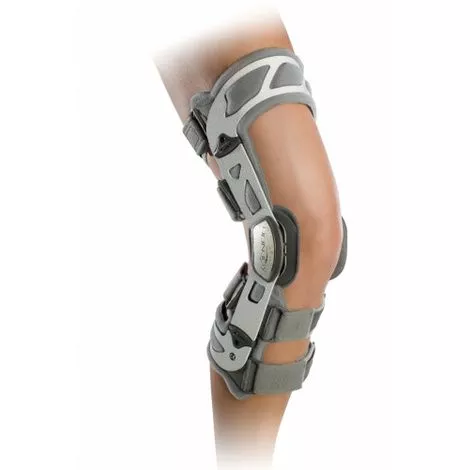
Donjoy Osteoarthritis Knee Brace Features
- Unlimited Comfort – Malleable magnesium frame allows cuff adjustment and delivers patient compliance
- Light as Air – Material science collides with innovation to create the world’s lightest OA knee brace
- Stays in Place – Contoured design enhances brace suspension for various levels of activity
- Dependable Off-Loading – New world material nano MAGTM (on the loading side) provides strength when offloading
- Clinically Proven – DonJoy’s Adjuster technology off-loads (mechanically shifts weight away from the damaged part of the knee) a little – or a lot
- Revolutionary in weight and profile – OA Nano offers industry-leading high-tech comfort and pain relief, ensuring that patients will choose this safe, non-invasive treatment over other options
- Light weight – World’s lightest knee brace at 14.2 ounces
Why use this Product?
- The Arthritis Foundation has honored DonJoy knee braces with its coveted “Ease-of-Use” commendation after an independent research lab conducted rigorous testing to ensure that they met the needs of people with functional limitations due to the effects of arthritis
What to buy with a Knee Brace
- Aircast Cryo/Cuff IC Cooler with Integrated Pump
- Aircast Knee Cryo/Cuff
- Donjoy Dura Soft Knee Sleeve and Knee Wrap
How to use Donjoy Unloader Knee Brace?
- While seated at the edge of a chair, flex your knee to 45° and slip on the brace. (Fig 2)
- Center the hinges 1 inch (2.5 cm) above the top of the knee cap and slightly behind the midline of the leg, and attach straps 1 and 2. (Fig 3)
- Push both hinges toward the back of the leg and then attach strap 3(Fig 4)
- Draw the hinges forward slightly, but not beyond the midline of the leg, and attach the anti-migration band. Then attach straps 4 and 5(Fig 5). For OA Nano and 4Titude OA Nano, an anti-migration band will need to be applied in the accessory bag. See antimigration band application instructions.
- The hinges should center just above the top of the knee cap and slightly behind the midline of the leg. (Fig 6)
- Once the brace is on, perform knee bends and walk around to verify no brace slippage occurs. (Fig 7). If necessary, tighten the straps in the numbered order. The strap lengths can be adjusted beneath the strap pad. (Fig 8)
How to apply the strap pad (For OA Nano only)?
- For additional comfort, five (5) strap pads are included in the accessory bag.
- These are placed internally on each strap (via Velcro attachment) to enhance overall fit and comfort.
How to apply an anti-migration band?
- The anti-migration band enhances brace suspension (if needed).
- Separate application instructions are located in the accessory bag for the OA Nano and 4Titude OA Nano users.
- The anti-migration band is already attached to all OA Adjuster versions.
- If removed, please reference the application instructions to reapply.
How to install a hinge stop?
- Detach both condyle pads. Insert 10° extension stops into the front of both hinges.
- Insert and tighten supplied screws into both hinges.
- Re-attach both condyle pads.
How to clean this Knee Brace?
- Regular Cleaning of components is recommended.
- A dry lubricant such as TeflonTM spray may be applied to the hinge’s internal mechanism and is recommended following use in water.
- Inspect the hinge screws periodically and tighten them if loose.
- To clean liners and condyle pads, hand wash in 30° C / 85°F cold water using mild soap, rinse thoroughly, and air dry.
- Residual soap may cause irritation and deteriorate the material.
Donjoy Knee Brace Instructions
What is Osteoarthritis?
What are the Causes?
The exact cause of OA is not yet known, but causal factors include, but are not limited to:
- Natural aging and wear and tear.
- Bleeding disorders cause bleeding in the joint, such as hemophilia.
- Disorders that block the blood supply near a joint lead to avascular necrosis.
- Other types of arthritis, such as chronic gout, pseudogout, or rheumatoid arthritis.
- OA can develop within 10 years of a major joint injury. For example, a teenager who tears their ACL at age 15 could begin to develop OA as early as age 25 or 30.
What are the Symptoms?
Osteoarthritis can remain undetected until a significant portion of joint cartilage has worn away. Signs to look for include, but are not limited to:
- Joint pain, tenderness, stiffness, and locking
- Joint swelling (bones around the joints may feel larger than normal)
- Ligaments and muscles around a joint become weaker and stiffer
- A cracking or grating sound when a joint is moved
- Limited range of joint motion
Prevalence for Osteoarthritis
- Nearly 27 million U.S. adults age 25 and older have Osteoarthritis (OA), a number expected to increase with longer life expectancies, the obesity epidemic, and the approaching wave of 78.2 million baby boomers reaching retirement age.
- Supporting this prediction, nearly one in two people may develop symptomatic knee OA by age 85, and half of all adults will develop symptomatic OA of the knee at some point in their lives.
- By 2030, a projected 67 million people will have doctor-diagnosed arthritis.
- Two of every three obese adults are at risk of developing OA.
- Before age 45, more men than women have osteoarthritis; after age 45, it is more common in women.
What are the risk factors for developing OA?
Certain factors that increase the risk of developing OA include, but are not limited to:
- Heredity
- Being overweight
- Joint injury
- Repeated overuse of certain joints
- Lack of physical activity
- Nerve injury
- Aging
Potential complications from Osteoarthritis
Other complications may arise from osteoarthritis. They include, but are not limited to:
- Pain that causes stiffness and loss of movement ability
- Muscle spasms and contractions in affected tendons
- Fluid accumulation in the joint
- Crackling noises in the joint
- Hard bony enlargements, nodes, or bunions form around the joint